SRMP: assignment 4
Part 1/2 (JASP)
Open the dataset Assignment4_data. These are data from a real study on morbid curiosity (Oosterwijk, 2017) where participants were asked to make choices regarding the viewing of negative, positive or neutral images. In each trial, participants were presented with two short verbal descriptions of images (a negative image and a neutral or positive alternative) and asked which image they wanted to view. After they made a choice, the chosen image was presented on the computer screen. The verbal descriptions aimed to mimic a common way in which people are confronted with information that may trigger morbid curiosity in daily life, such as headlines in a newspaper or image links on the internet (e.g., Facebook, YouTube).
The independent variable Category (social vs. physical) reflected whether the negative target and the alternative had social content (e.g., it involved people interacting) or physical content (e.g., it involved a close-up of a human body part). The independent variable Combination (neutral vs. positive) reflected whether the alternative was neutral or positive. The participants made 56 choices in total, and the DV is expressed in the datafile as the proportion of trials on which a negative image was chosen. Note that each participant completed trials in all of the study’s conditions.
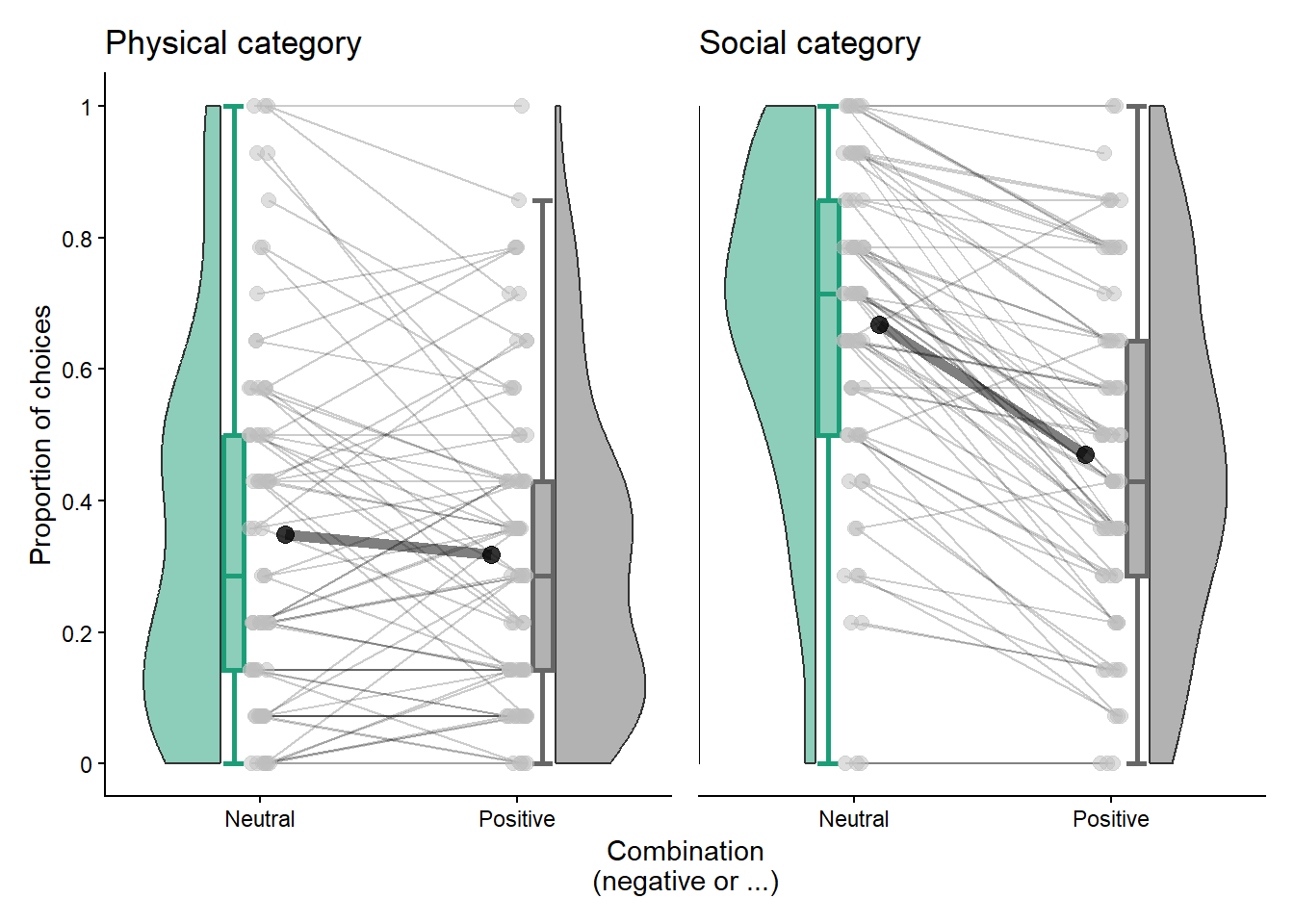
- Visualize the data using a graph appropriate for the design and paste this into your submission. (3 points)
- Points for a nice plot (1) showing means (1) and dispersion (1) for all conditions (e.g., barplot/lineplot with errorbars, or box/rainplot).
- State the most appropriate test to run on these data. Run this test, and interpret all relevant output, with reference to supporting descriptive statistics. (7 points)
- (Factorial) repeated measures ANOVA should be selected (1)
- Significant main effect of
Category(1): overall, people chose negative images with social content more often than negative images with physical content (1). - Significant main effect of
Combination(1): overall, people chose negative images more often when the alternative was neutral than when the alternative was positive (1).
- Significant interaction effect (1): within the social category, people chose negative images significantly more often when the alternative was neutral than when it was positive (p < .001), but there was no difference in the proportion of negative choices between the neutral and positive alternative conditions within the physical category (p = .153). (1)
- Do you have concerns about the assumption of sphericity in these data? Give your reasoning for why (not). (2 points)
- Although the data belong to a fully repeated-measures design, there are no concerns regarding sphericity violations as each IV contains only two levels (2).
Part 2/2 (Conceptual)
We return to the work of Prof. Vogel from the previous assignment. Recall that she was interested in whether birds favoured sausage rolls from a particular producer (Albert Heijn vs. Kiosk) and she how also believed that older birds might peck less at pastries regardless of the producer. In a follow-up experiment, Vogel conducts an analysis where she first tests whether there is an effect of producer without controlling for age and obtains a non-significant result (p = .07). She then reruns the analysis controlling for age and finds a significant effect (p = .04). She reports only the latter finding.
- Why would this be considered questionable research practice? (1 point)
- Running two non-independent analyses increases the type-I error rate, meaning that \(\alpha\) > .05. If Vogel does not disclose all tests she performed, then she misleads if she reports her results as signficant at \(\alpha\) = .05(1)
- Suggest two actions Vogel could have taken to avoid this. (2 points)
- She could have reported both analyses and adjusted \(\alpha\) (1) or she could have decided before the analysis to include the covariate and only run this analysis (1).
References
Oosterwijk, S. (2017). Choosing the negative: A behavioral demonstration of morbid curiosity. PLOS ONE, 12(7), 1–20. https://doi.org/10.1371/journal.pone.0178399